Description
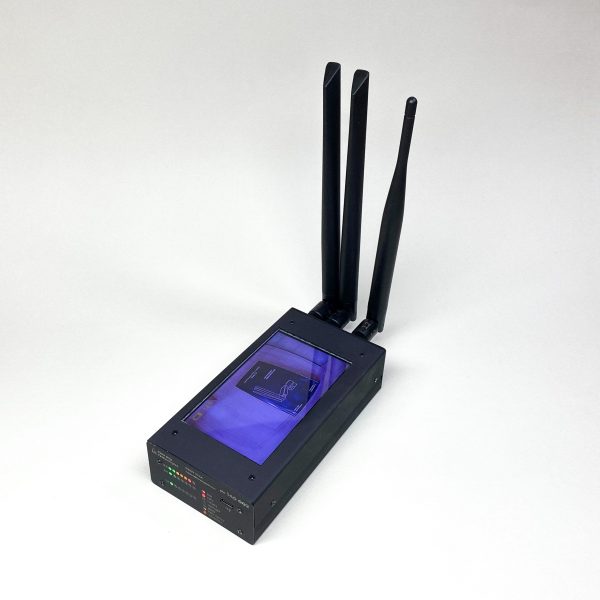
The detector continuously scans the 1.2, 2.4 or 3.3 GHz (optional), and 4.9–6.0 GHz frequency bands, used by most quadcopters and FPV drones, and alerts the user to the presence and approach of drones.
There are two main triggers for detection alerts:
-
The presence of any radio signal exceeding the activation threshold on the same frequency for at least 4 seconds.
-
The presence of an analog video signal (on any frequency and for any duration), which is typically used by FPV drones.
To reduce false alarms, the system uses signal fingerprint verification, adjustable sensitivity thresholds, short signal filtering, and WiFi/Bluetooth channel filtering. This ensures stable operation with minimal false positives.
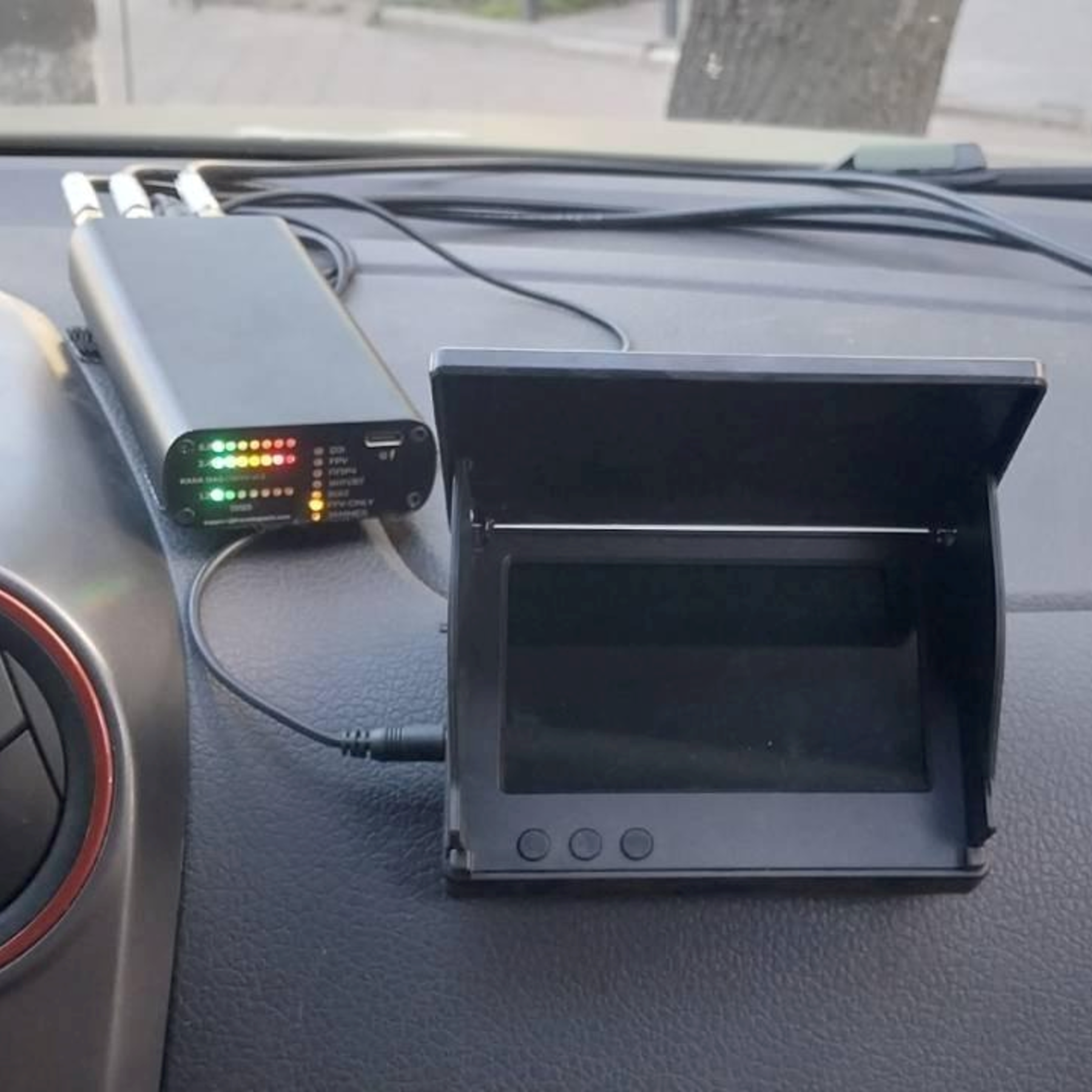
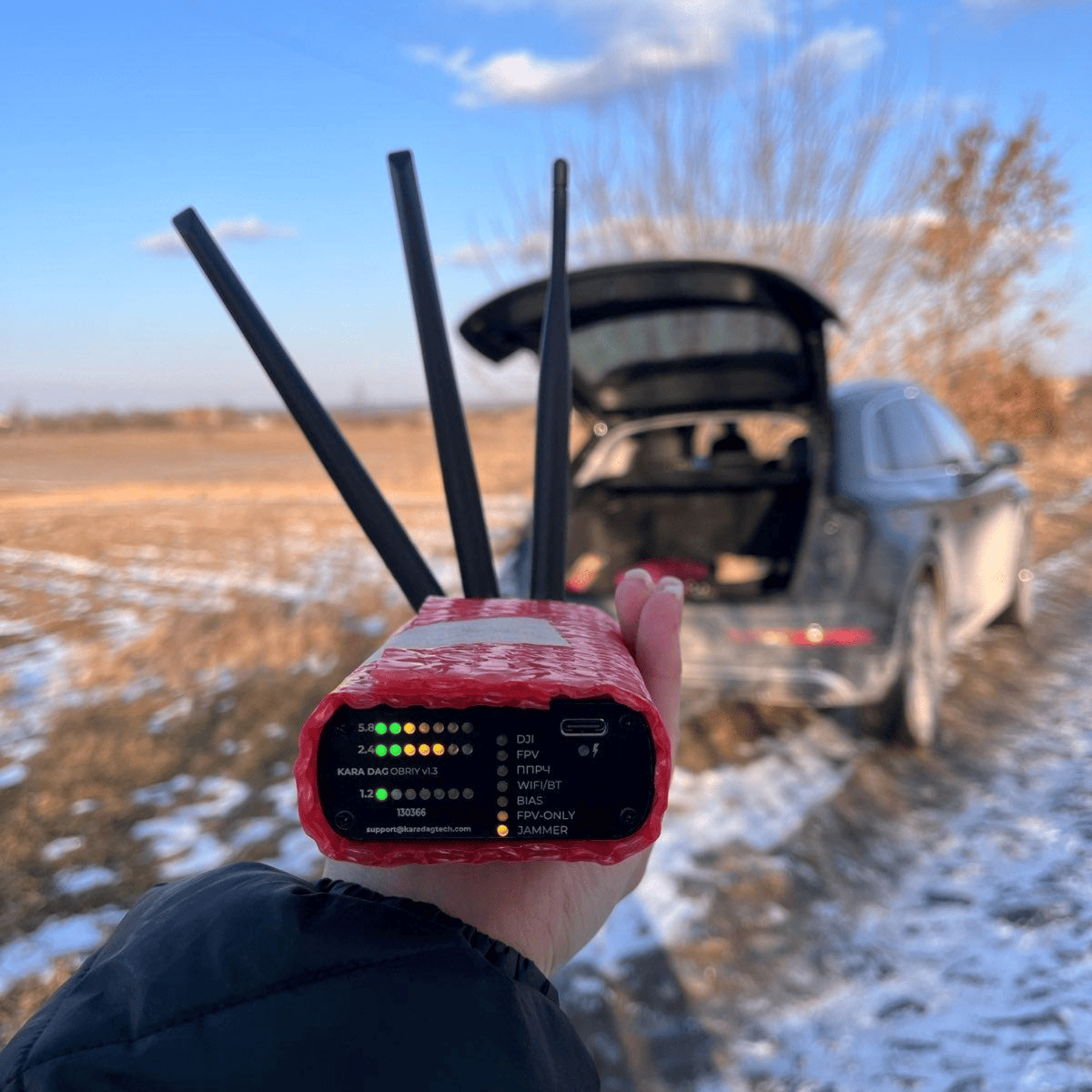
When a signal is detected, the device alerts the user via light, vibration, and sound. Signal strength is displayed on the rear panel and also indicated through the frequency of audio beeps. Based on these cues, the user can estimate the drone’s distance and direction of movement using the “Direction Finding” mode.
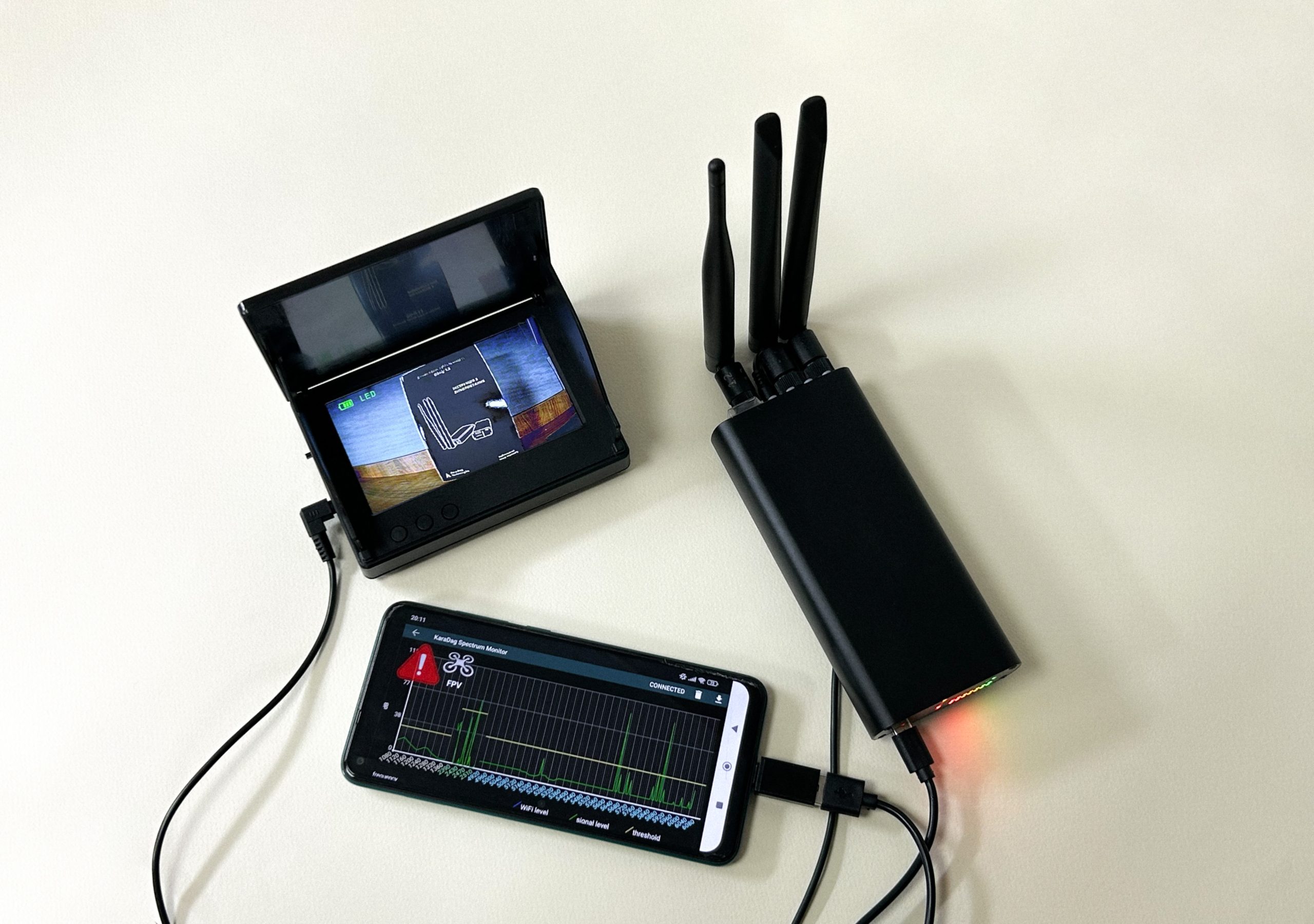
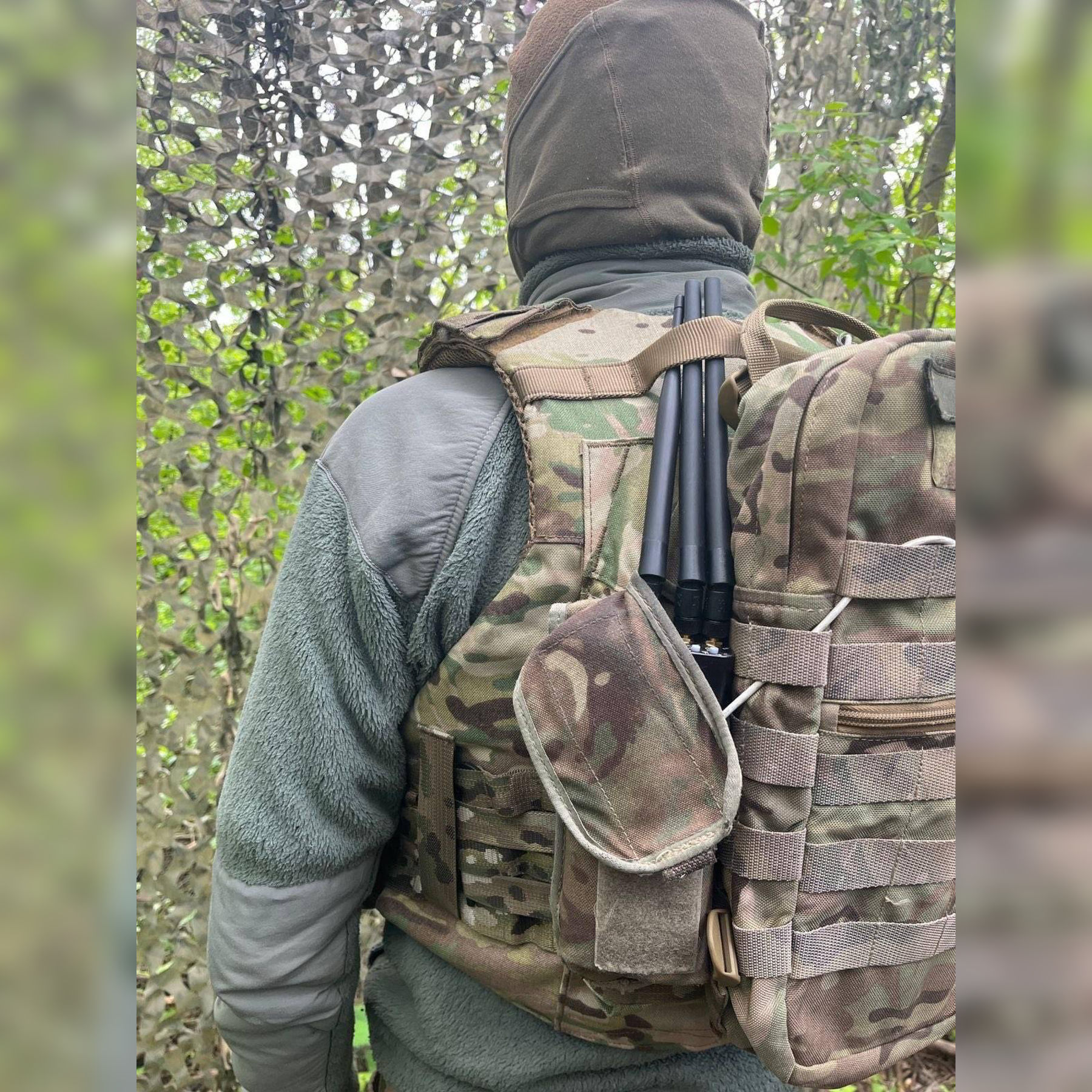
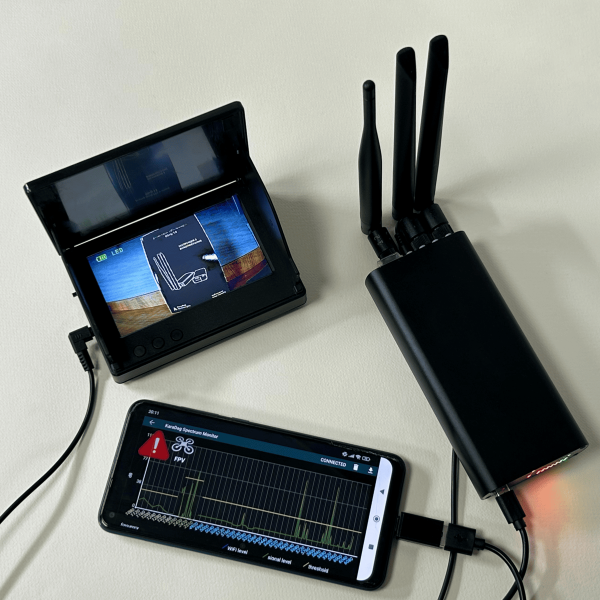
The detector can operate autonomously (e.g., in a pocket) or be connected to an external screen via a 3.5 mm jack to output intercepted video.
Features and Functionality
- Analog video interception and output to an external screen. Note: the monitor is not included and can be purchased separately [here]. There’s also an option to stream the intercepted video to a PC.
- WiFi and Bluetooth filtering. In this mode, the device scans and identifies the bands used by WiFi and Bluetooth, then ignores all signals in those specific ranges to reduce false alarms.
- Integration with electronic warfare (EW) systems. The device features an output for EW activation, enabling seamless integration with nearly any EW system with minimal modifications. The EW system will be triggered automatically when drones are detected nearby.
- Spectrum viewing. Spectrum data can be visualized via an Android app or on a PC. The device can also transmit data to a command post or integrate with operational information systems. It outputs spectrum analyzer data and threat detection information via Type-C using Serial over USB.
- Frequency calibration for specific antennas and environments. Calibration is a critical function that adapts the detector to specific surroundings and connected antennas, ensuring proper performance in various radio conditions. It reduces false positives and helps detect non-standard signals. During calibration, the device analyzes the environment and sets optimal thresholds automatically.
- Adjustable sensitivity thresholds. Users can increase or decrease sensitivity levels for individual bands (1.2, 2.4, 4.9–6.0 GHz) to fine-tune detection range and performance based on their needs.
- Threat direction finding. By using a directional antenna in “Direction Finding” mode, the user can determine the direction of the threat.
- “FPV Only” mode. Filters out all signals except FPV transmissions, minimizing false alerts in environments with heavy WiFi or EW activity.
- Headphone output. The alarm signal and directional guidance can be transmitted to headphones.
- “Blackout” mode. Disables all LEDs for stealth operation in tactical environments.
- Power supply via Bias-T for 5.8 GHz antennas. Supports external antennas (up to 10 m cable length) with built-in amplifiers powered directly by the device via Bias-T.
- Selective band muting. Allows deactivation of specific bands (1.2, 2.4, or 4.9–6.0 GHz), meaning the detector will ignore signals in those bands even if the threshold is exceeded.
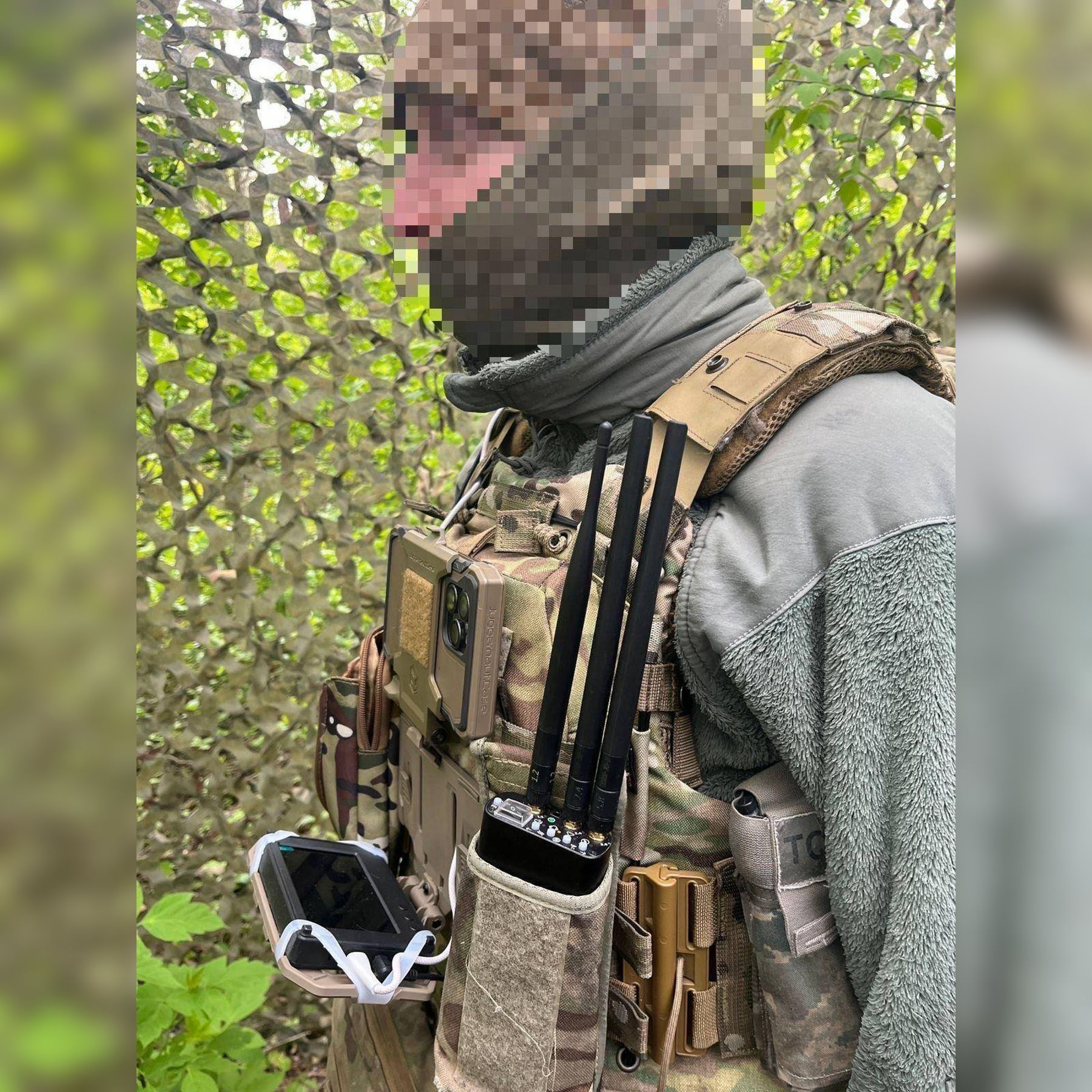
- Military-grade: fully metal casing, waterproof (IP65), lightweight (380g), compact (similar in size to a mobile phone, but thicker)
- Can be integrated into UAVs and stores detection statistics for analytics
Technical Specifications
| Operating Bands | 1.2 GHz, 2.4 GHz, 4.9–6.0 GHz |
| Frequency Ranges | 1080–1360 MHz (40 MHz steps)
2370–2510 MHz (5 MHz steps)
4900–6050 MHz (5 MHz steps) |
| Sensitivity | –85 dBm on 2.4 and 5.8 GHz bands
–95 dBm on 1.2 GHz band |
| Battery Capacity | 10 000 mAh |
| Battery Life | up to 8 hours |
| Charging Time | 6–8 hours |
| Ports | USB Type-C |
| Material | 100% anodized aluminum, 1–2 mm thick |
| Ingress Protection | IP65 |
| Connectors | USB Type-C, Jack 3.5, SMA(х3) |
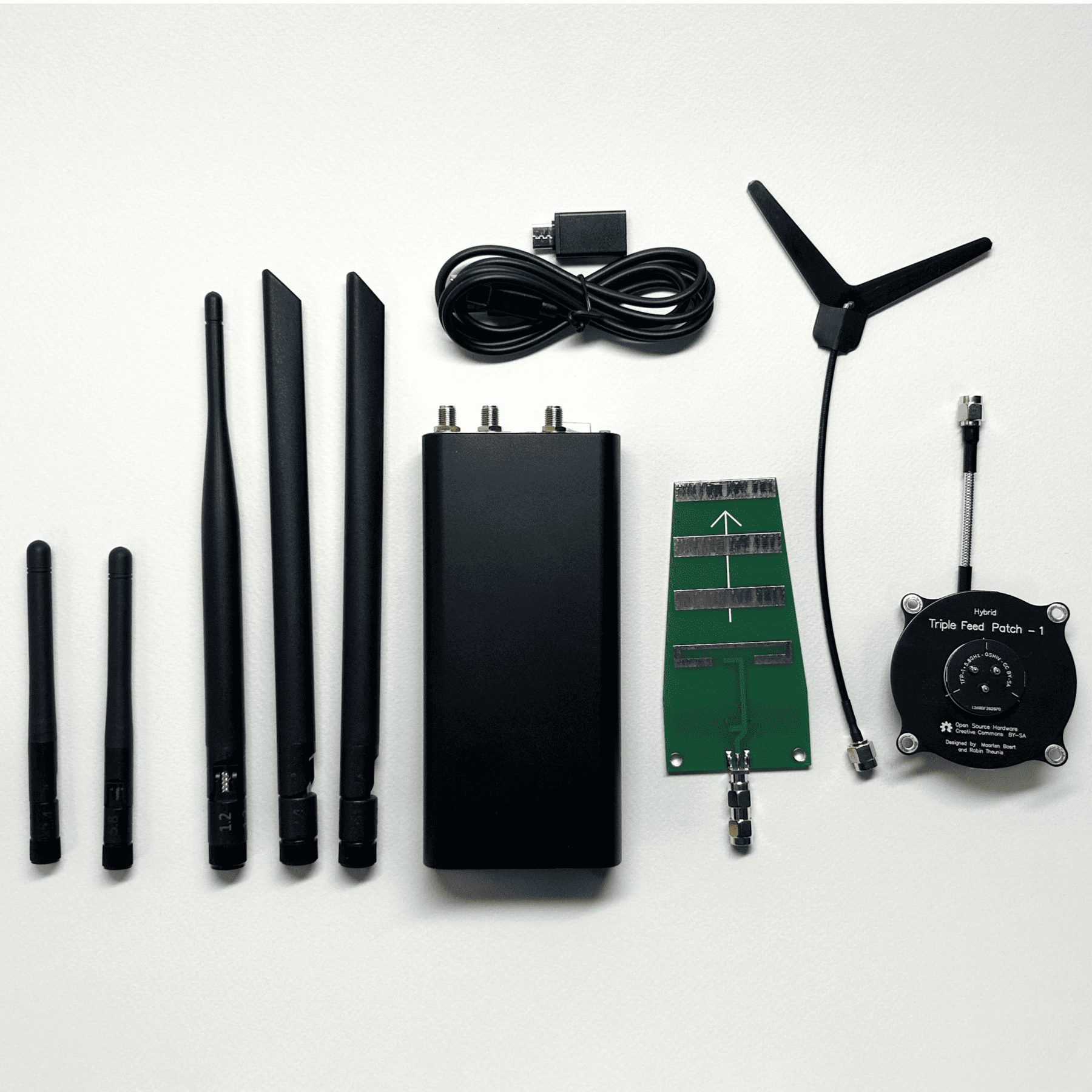
| Antennas Included | Three long omnidirectional antennas for 1.2 GHz, 2.4 GHz, and 5.8 GHz
Two short omnidirectional antennas for 2.4 GHz and 5.8 GHz
Directional antennas for 2.4 GHz and 5.8 GHz
Dipole antenna for 1.2 GHz |
| Additional Accessories | USB Type-C cable, user manual |
| Alert Modes | Vibration, sound, LED indication – each can be disabled individually if needed |
| Weight with Antennas | 380 ±10 g |
| Weight without Antennas | 330 ±10 g |
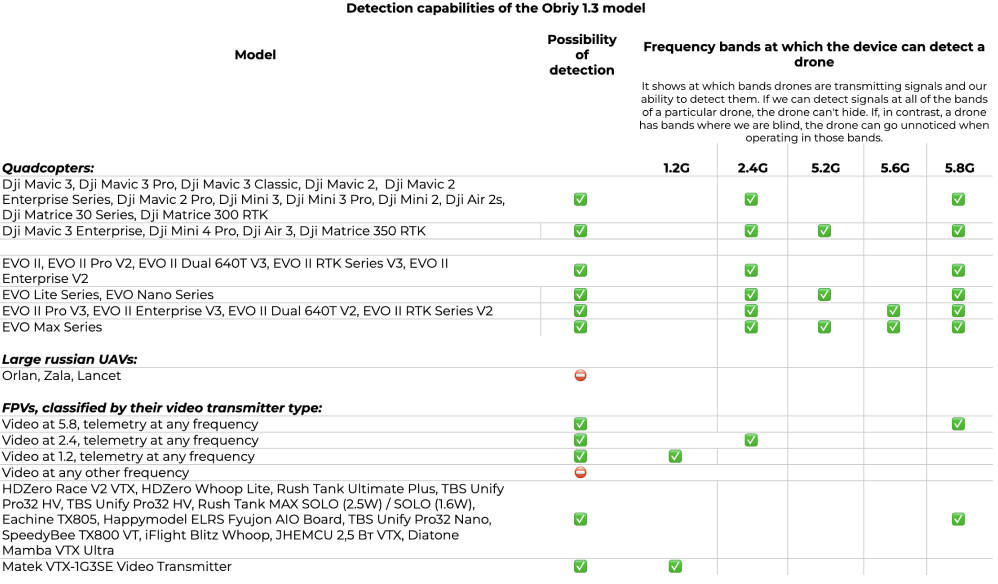
Detection Speed
1080 – 1360 MHz, FPV 2–4 s
1080 – 1360 MHz, DJI Mavic 3–4 s
2370 – 2510 MHz, FPV 2–5 s
2370 – 2510 MHz, DJI Mavic 3–5 s
4900 – 6050 MHz, FPV 3–5 s
4900 – 6050 MHz, DJI Mavic 3–6 s
Testing was conducted under conditions where the number of signals exceeding the activation threshold did not exceed 5.
If the number of such signals is higher, the device checks each for the presence of a video signal.
Each such check adds approximately 200 ms to the detection delay.






Reviews
There are no reviews yet.